
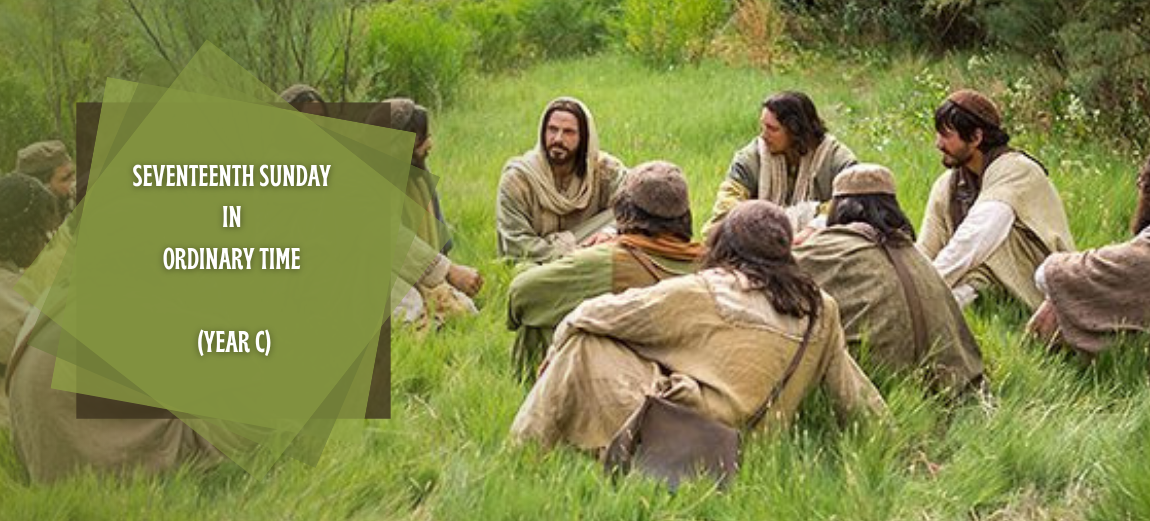
Gn 18:20-32; Ps 138; Col 2:12-14; Lk 11:1-13

Commentary
Praying in Christ’s School of Mission
Just as in the last two Sundays, today’s Gospel puts us in Christ’s school to learn from him another fundamental aspect in the life of discipleship: the action of praying. I use here intentionally the verb and not the noun (prayer), because Jesus’ teaching in this regard in today’s Gospel passage seems to want not so much to clarify the concept in the minds of the disciples as to help them form in themselves a habit of praying, as their teacher practiced. From among the Evangelists, it is no coincidence that St. Luke alone emphasizes that it all begins with a particular time context, “Jesus was praying in a certain place, and when he had finished, one of his disciples said to him, ‘Lord, teach us to pray.’” This proved to be a favourable time for the Master of Nazareth to impart to his disciples, by example and in words, the three essential points to follow in their praying.
1. “Father, Your Kingdom come.” The Priority of Praying for the Coming of the Kingdom of God.
Firstly, Jesus teaches his disciples to pray to God with a short text, later called in the Christian tradition the Lord’s Prayer. Unlike the version in Matthew’s Gospel, which is used in the Church’s liturgy, Luke’s version is shorter and contains only five invocations, instead of seven as found in Matthew’s version. Two invocations deal with divine reality and three with human reality. Each phrase of this precious and unique prayer text, which Jesus taught his disciples, contains an immense richness to be discovered and deepened. (I invite you to read the part dedicated to the Lord’s Prayer in the Catechism of the Catholic Church [nos. 2803 et seq.]). Let us recall here the most important aspect, concerning the “missionary” character.
Indeed, in both versions, after addressing God as “Father,” which puts the one who prays in a special filial relationship with God, the prayer begins with two parallel requests: that of the sanctification of his name and that of the coming of his kingdom. They are in some ways complementary, for there where God reigns, His “name,” meaning He Himself, is “hallowed” and “glorified,” that is, recognized and adored as holy. (cf. Catechism of the Catholic Church no. 2807).In these initial invocations, we glimpse the great desire for God’s saving plan for us that Jesus constantly carried in his heart and now wants to convey to his disciples. He himself proclaimed from the very beginning of his public activities that “the Kingdom of God is at hand” or, even better, “has come nearer” in a dynamic way.
It should be clarified that the coming of the kingdom of God does not mean the establishment of a territory with visible boundaries under God’s direct control. Rather, such coming implies that God reigns over his people and, generally, in the hearts of men and women, precisely in accordance with the Old Testament tradition, which uses the verbal expression “God rules” much more frequently than “Kingdom of God”. The same Old Testament texts also express the expectation of the day when God will come to reign over everything and everyone. In this way, the invocation of the coming of the kingdom of God actually calls for God to carry out his plan of salvation in the world.
The Lord’s Prayer, therefore, shows itself to be above all a “missionary” prayer. Those who pray it share the same desire of God, which is then also that of Christ, for the fulfillment of the missio Dei, that mission of God for the happiness of humanity, which has now come in the fullness of time with the coming of Jesus. Those who pray it also wish for themselves and for all humankind the sweet “yoke of the kingdom,” that God may reign in their lives as well as in the lives of every man and woman in the world. Such prayer is, par excellence, the first action of mission.
2. Praying with Insistence and Filial Trust
Secondly, Jesus teaches how to pray to God with insistence (“intrusiveness”) and filial trust. He does this through a short parable, which reflects various aspects of the culture of his people: the arrival of the friend without any notice “at midnight” from a trip (there was certainly no mobilephones at that time), staying in bed with or near the children (according to the structure of the house at the time), hence the fear of waking them up by getting up, and especially the strange fact that the master of the house did not think of the possibility of punishing his intrusive friend by calling the “police”.
In any case, as is clear from the literary context, the attitude of insistence in praying seems to be recommended not so much for every need of the person praying, sometimes only according to his human needs, but precisely in view of the request for essential things that Jesus had taught in the Lord’s Prayer, particularly that invocation for coming of the kingdom. Such a perspective will also apply to Jesus’ statement later on, which has been repeatedly misunderstood and abused: “ask and you will receive; seek and you will find; knock and the door will be opened to you. For everyone who asks, receives; and the one who seeks, finds; and to the one who knocks, the door will be opened” (Lk 11:9-10). What should we ask for? What are we seeking? Upon whose door do we knock? Jesus’ response is clear: “But seek first the kingdom [of God] and his righteousness, and all these things will be given you besides” (Mt 6:33).
3. “Praying” All Oriented to the Gift of the Holy Spirit
Finally, Jesus concludes his “catechesis” on praying by pointing to the Holy Spirit as the supreme good to ask for and receive from God: “If you then, who are wicked, know how to give good gifts to your children, how much more will the Father in heaven give the Holy Spirit to those who ask him?” (Lk 11:13). This is already glimpsed from the parallelism between “good things” that an earthly father knows how to give to his children and “the Holy Spirit” that the heavenly Father will give to those who ask for it. The thought emerges even more clearly when comparing this version of Jesus’ saying with the one in Matthew’s gospel, which makes the saying more straightforwardand more logical, “If you then, who are wicked, know how to give good gifts to your children, how much more will your heavenly Father give good things to those who ask him” (Mt 7:11).
In this way, Jesus’ teaching in the Lucan version is even richer because it orientates everything toward the greatest gift God can bestow on humanity: the Holy Spirit who purifies, sanctifies, and guides every man and woman into life with God, and in God. Where the Spirit is, there God is present and reigning, and there the kingdom of God is present. Therefore, praying to God for the gift of the Holy Spirit actually amounts to praying for the coming of the kingdom of God in ourselves. It will also be the Spirit who will help us enter more and more into the filial relationship with God whom we now call “Abba, Father” (cf. Rom 8:15-16), just as Jesus taught us.
So let us ask to be given always and even today this supreme gift of God that is the Holy Spirit, with the assurance that God our Father in heaven will give it to us. And “led by the Spirit of Jesus,”may we daily raise to the Father the essential invocations of the Lord’s Prayer with insistence and filial confidence, pleading with all our strength that God’s kingdom will come among us. Amen.

Useful points to consider:
CATECHISM OF THE CATHOLIC CHURCH
2781 When we pray to the Father, we are in communion with him and with his Son, Jesus Christ. Then we know and recognize him with an ever-new sense of wonder. The first phrase of the Our Father is a blessing of adoration before it is a supplication. For it is the glory of God that we should recognize him as “Father,” the true God. We give him thanks for having revealed his name to us, for the gift of believing in it, and for the indwelling of his Presence in us.
2804 The first series of petitions carries us toward him, for his own sake: thy name, thy kingdom, thy will! It is characteristic of love to think first of the one whom we love. In none of the three petitions do we mention ourselves; the burning desire, even anguish, of the beloved Son for his Father’s glory seizes us: “hallowed be thy name, thy kingdom come, thy will be done….” These three supplications were already answered in the saving sacrifice of Christ, but they are henceforth directed in hope toward their final fulfillment, for God is not yet all in all.
2807 The term “to hallow” is to be understood here not primarily in its causative sense (only God hallows, makes holy), but above all in an evaluative sense: to recognize as holy, to treat in a holy way. and so, in adoration, this invocation is sometimes understood as praise and thanksgiving. But this petition is here taught to us by Jesus as an optative: a petition, a desire, and an expectation in which God and man are involved. Beginning with this first petition to our Father, we are immersed in the innermost mystery of his Godhead and the drama of the salvation of our humanity. Asking the Father that his name be made holy draws us into his plan of loving kindness for the fullness of time, “according to his purpose which he set forth in Christ,” that we might “be holy and blameless before him in love.”
2809 The holiness of God is the inaccessible center of his eternal mystery. What is revealed of it in creation and history, Scripture calls “glory,” the radiance of his majesty. In making man in his image and likeness, God “crowned him with glory and honor,” but by sinning, man fell “short of the glory of God.” From that time on, God was to manifest his holiness by revealing and giving his name, in order to restore man to the image of his Creator.
Pope Francis, General Audience, St Peter’s Square, Wednesday, 22 May 2019
We can say that Christian prayer arises from the courage to address God with the name ‘Father’. This to say ‘Father’ to God. But it takes courage! It is not so much a matter of a formula, as much as a filial intimacy into which we are introduced by grace: Jesus is the revealer of the Father and he gives us intimacy with him. He “does not give us a formula to repeat mechanically. As in every vocal prayer, it is through the Word of God that the Holy Spirit teaches the children of God to pray to their Father” (ccc, n. 2766). Jesus himself used different expressions to pray to the Father. If we read the Gospels carefully, we discover that these expressions of prayer that come from Jesus’ lips recall the text of the “Our Father”. […]
When considering the New Testament as a whole, one can clearly see that the first protagonist of every Christian prayer is the Holy Spirit. But let us not forget this: the protagonist of every Christian prayer is the Holy Spirit. We could never pray without the power of the Holy Spirit. It is he who prays within us and moves us to pray well. We can ask the Holy Spirit to teach us to pray because he is the protagonist, the one who makes the true prayer within us. He breathes into the heart of each of us who are Jesus’ disciples. The Holy Spirit makes us able to pray as children of God, as we truly are by our Baptism. The Holy Spirit helps us pray in the ‘furrow’ that Jesus ploughed for us. This is the mystery of Christian prayer: by grace we are attracted to that dialogue of love of the most Holy Trinity. […] In order to pray, we have to make ourselves little so that the Holy Spirit may come within us and may be the One to lead us in prayer.