
EVENING MASS ON THE EVE
1 Chr 15,3-4,15-16; 16,1-2; Ps 131; 1Cor 15,54-57; Luke 11:27-28
MASS OF THE DAY
Rev 11,19a; 12,1-6a.10ab; Ps 44; 1Cor 15,20-27a; Luke 1:39-56

Commentary
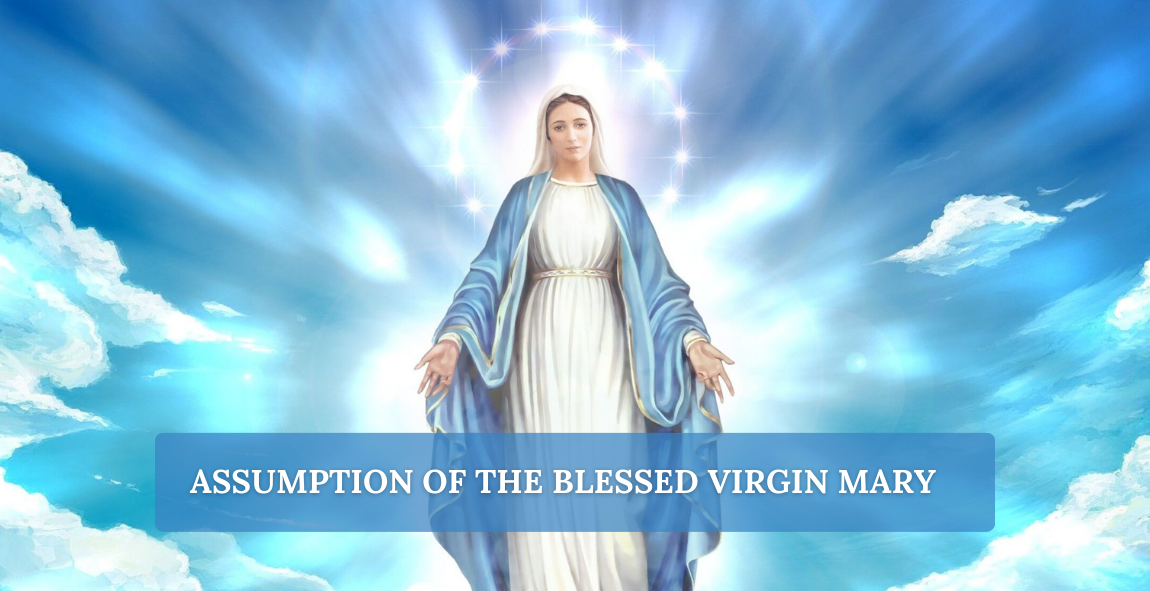
The Mystery of Mary Assumed into Heaven
The solemnity of the Assumption of Mary, listed in the Roman Calendar on August 15, is celebrated in many countries on the Sunday following this date to facilitate the participation of the faithful in this mass of obligation. Therefore, together with the usual comment on the Sunday Gospel, I add here three brief thoughts to further delve into the mystery of the Assumption of Mary in the light of the Gospel for this celebration and above all on the basis of the teaching of the Church.
1. Did Mary die or not? A Necessary Clarification on the “Dormition of Mary”
On this discussion, crucial for a correct theological and spiritual vision of the mystery of the Assumption of Mary, it is necessary to recall the authoritative teaching of Saint John Paul II which, due to its catechetical importance, I take the liberty of reporting in full, marking in yellow the salient points (cf. General Audience, Wednesday, 25 June 1997 ; https://www.vatican.va/content/john-paul-ii/en/audiences/1997/documents/hf_jp-ii_aud_25061997.html):
Mary and the human drama of death
1. Concerning the end of Mary’s earthly life, the Council uses the terms of the Bull defining the dogma of the Assumption and states: “The Immaculate Virgin, preserved free from all stain of original sin, was taken up body and soul into heavenly glory, when her earthly life was over”(Lumen gentium, n. 59). With this formula, the Dogmatic Constitution Lumen gentium, following my Venerable Predecessor Pius XII, made no pronouncement on the question of Mary’s death. Nevertheless, Pius XII did not intend to deny the fact of her death, but merely did not judge it opportune to affirm solemnly the death of the Mother of God as a truth to be accepted by all believers.
Some theologians have in fact maintained that the Blessed Virgin did not die and was immediately raised from earthly life to heavenly glory. However, this opinion was unknown until the 17th century, whereas a common tradition actually exists which sees Mary’s death as her entry into heavenly glory.
2. Could Mary of Nazareth have experienced the drama of death in her own flesh? Reflecting on Mary’s destiny and her relationship with her divine Son, it seems legitimate to answer in the affirmative: since Christ died, it would be difficult to maintain the contrary for his Mother.
The Fathers of the Church, who had no doubts in this regard, reasoned along these lines. One need only quote St Jacob of Sarug (†521), who wrote that when the time came for Mary “to walk on the way of all generations”, the way, that is, of death, “the group of the Twelve Apostles” gathered to bury “the virginal body of the Blessed One” (Discourse on the burial of the Holy Mother of God, 87-99 in C. Vona, Lateranum 19 [1953], 188). St Modestus of Jerusalem (†634), after a lengthy discussion of “the most blessed dormition of the most glorious Mother of God”, ends his eulogy by exalting the miraculous intervention of Christ who “raised her from the tomb”, to take her up with him in glory (Enc. in dormitionem Deiparae semperque Virginis Mariae, nn. 7 and 14: PG 86 bis, 3293; 3311). St John Damascene (†704) for his part asks: “Why is it that she who in giving birth surpassed all the limits of nature should now bend to its laws, and her immaculate body be subjected to death?”. And he answers: “To be clothed in immortality, it is of course necessary that the mortal part be shed, since even the master of nature did not refuse the experience of death. Indeed, he died according to the flesh and by dying destroyed death; on corruption he bestowed incorruption and made death the source of resurrection” (Panegyric on the Dormition of the Mother of God, n. 10: SC 80, 107).
3. It is true that in Revelation death is presented as a punishment for sin. However, the fact that the Church proclaims Mary free from original sin by a unique divine privilege does not lead to the conclusion that she also received physical immortality. The Mother is not superior to the Son who underwent death, giving it a new meaning and changing it into a means of salvation.
Involved in Christ’s redemptive work and associated in his saving sacrifice, Mary was able to share in his suffering and death for the sake of humanity’s Redemption. What Severus of Antioch says about Christ also applies to her: “Without a preliminary death, how could the Resurrection have taken place?” (Antijulianistica, Beirut 1931, 194f.). To share in Christ’s Resurrection, Mary had first to share in his death.
4. The New Testament provides no information on the circumstances of Mary’s death. This silence leads one to suppose that it happened naturally, with no detail particularly worthy of mention. If this were not the case, how could the information about it have remained hidden from her contemporaries and not have been passed down to us in some way?
As to the cause of Mary’s death, the opinions that wish to exclude her from death by natural causes seem groundless. It is more important to look for the Blessed Virgin’s spiritual attitude at the moment of her departure from this world. In this regard, St Francis de Sales maintains that Mary’s death was due to a transport of love. He speaks of a dying “in love, from love and through love”, going so far as to say that the Mother of God died of love for her Son Jesus (Treatise on the Love of God, bk. 7, ch. XIII-XIV).
Whatever from the physical point of view was the organic, biological cause of the end of her bodily life, it can be said that for Mary the passage from this life to the next was the full development of grace in glory, so that no death can ever be so fittingly described as a “dormition” as hers.
5. In some of the writings of the Church Fathers we find Jesus himself described as coming to take his Mother at the time of her death to bring her into heavenly glory. In this way they present the death of Mary as an event of love which conducted her to her divine Son to share his immortal life. At the end of her earthly life, she must have experienced, like Paul and more strongly, the desire to be freed from her body in order to be with Christ forever (cf. Phil 1:23).
The experience of death personally enriched the Blessed Virgin: by undergoing mankind’s common destiny, she can more effectively exercise her spiritual motherhood towards those approaching the last moment of their life.
2. Mary assumed into heaven is the pisteusasa “The-One-who-believed”: An important “evangelical” Marian title to underline
Therefore, as we can guess, that fundamental virtue called faith shines in Mary of the Assumption in all the moments, highs and lows, of her earthly life and therefore also of her death. So much so that in the Gospel foreseen for this Solemnity we hear the praise of Mary resounding on the lips of Elizabeth with the two very first “Marian titles” that the ancient Christian people reserved for her. She is called by Elizabeth as “Mother of [my] Lord” and “The one [woman] who believed [in the Word of God].” The last expression in the original Greek is actually just a word, an adjective participle “pisteusasa.” It also becomes a fundamental qualification to describe the person of Mary.
Our “Queen assumed into heaven” is also and above all the Believer par excellence, “The One who believed”. She always believed in the Word of God, in every moment of her life, from the joyful one of the angel’s Annunciation to the painful one under the Cross of his Son, as we glimpse in the Gospels. To use the words of Saint Paul the Apostle, Mary too walked through life, kept the faith, and now, at the moment of death, the crown of glory that God provides to his faithful, or rather, to His Most Faithful, is reserved for her, the masterpiece of the mission of the Trinity: Father, Son, and Holy Spirit. She thus becomes the Mother of all believers of God, disciples of Christ. She, to whom Christ himself entrusted his beloved disciple under the Cross, continues her maternal care and concern for all of Christ’s disciples in their lives and particularly in their journey of faith and mission. She continues to intercede for them and continues to be an example, inspiration and concrete help for them to persevere in faithfulness to the Lord and to complete the divine mission now entrusted by Christ to them in the world. Thus, She continues to accompany the entire Church today, the community of Christ’s missionary disciples, in its pilgrimage towards the eternal homeland.
3. The Sistine Chapel in the Vatican dedicated to Mary assumed into heaven
We end our brief reflection with an interesting historical note regarding the famous Sistine Chapel in the Vatican. It was consecrated on 15 August 1483, in the first mass of the Assumption of Mary, by Pope Sixtus IV, who had renovated the ancient Cappella Magna in the papal building. It was then dedicated to Mary Assumption into heaven and called the “Sistine Chapel” from the name of Pope Sixtus IV (who was also a Franciscan!). As informed by the official Vatican website, the Sistine Chapel was used in 1513 for the election of Leo X (1513-1521), in 1623 for the election of Urban VIII (1623-1644), and twelve more papal elections until 1775. Later, since 1878 to today, the Sistine Chapel has been the seat of every papal conclave for the election of the pope.
Thus, in the Chapel of which she is patron, Mary assumed into heaven continues to follow with maternal attention the most important events of the disciples of Christ and of the Church of God on earth, to take care of the popes elected in the past, present, and future. Therefore, grateful to God for the gift of Mary our Mother, we entrust to her once again today, on this Solemnity of her Assumption into heaven, the entire history of each of us, the history of our Church with our popes, the history of all humanity. Mary, Mother of our Lord and the One who believed, Queen assumed into heaven and Queen of missions, pray for us! Amen.
