
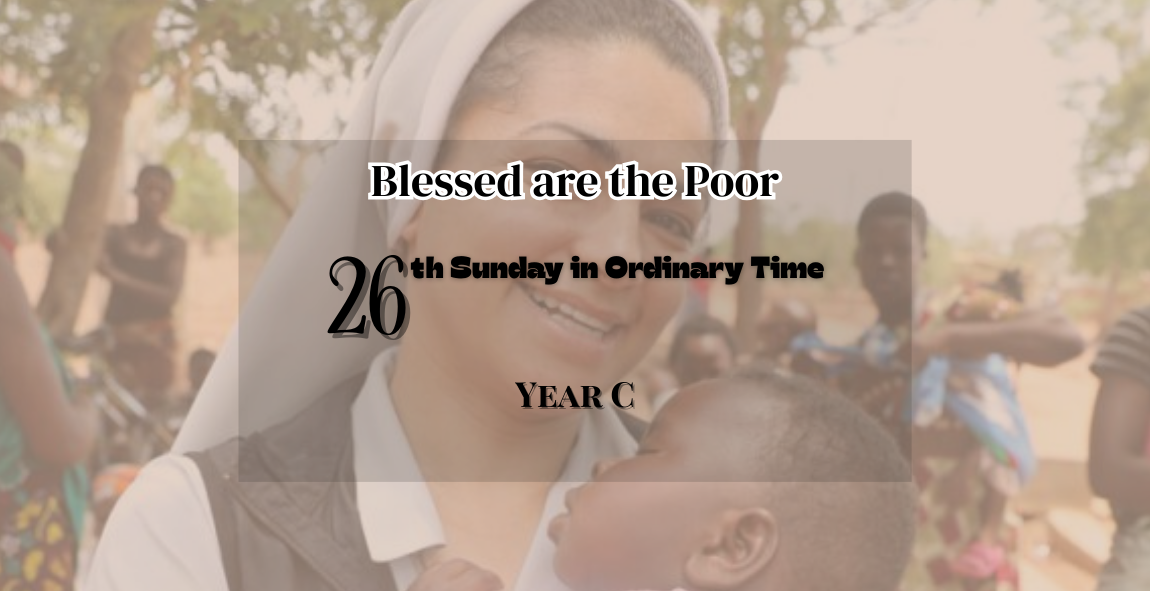

Am 6:1a,4-7; Ps 146; 1Tm 6:11-16; Lk 16:19-31
Commentary
Blessed are the poor
This Sunday’s Gospel is the one that, par excellence, gives good news to the poor. With this folk-tinged parable more than in others, Jesus conveys a clear message about the reversal of the fortunes of the poor and the rich in the afterlife and, through this, a strong warning to those who selfishly lock themselves in their wealth without noticing the needy around them. It is a kind of narrative illustration of the blessed-woe antithesis that Jesus had proclaimed at the beginning of his activities: “Blessed are you who are poor, for the kingdom of God is yours. (…) But woe to you who are rich, for you have received your consolation” (Lk 6:20,24). While the Gospel message is clear, – it is nevertheless worthwhile to dissect some interesting details of this parable, unique in the Gospels, for a more appropriate and even deeper understanding of what Jesus wants to teach us in our journey of faith and mission today.
1. The poor man and his sufferings in silence
The plight of the poor man in the parable is more than tragic, as can be perceived from the few but effective brush strokes that highlight his misery, “covered with sores, who would gladly have eaten his fill of the scraps that fell from the rich man’s table. Dogs even used to come and lick his sores.”Such description, indeed dramatization, of the physical aspects also hints at a certain suffering in the spirit of this poor man, abandoned by men because of the plagues and then “approached” only by dogs, animals considered unclean in Jewish tradition.
In the midst of such immense personal tragedy, what is striking is the poor man’s silence throughout the narrative. He, in fact, never spoke while alive and, remains without a word even after death, when “he was carried away by angels to the bosom of Abraham,” that is, to heavenly bliss with the patriarchs of Israel. This is in sharp contrast to the behavior of the rich man who, as we shall see below, was always making “noise” both before and after death!
The silence of the poor man in the parable gives pause for thought. Every disciple of Jesus will have to wonder and worry. There are still lots and lots of poor, needy, suffering people around us who do not raise their voices. They remain silent most of the time for one reason or another. We need perhaps to be even more attentive, more alert to these “silent voices” next door, who come from borderline, boundary situations. And this is especially true for Jesus’ disciples-missionaries, remembering what Pope Francis states in his Message for 2022 World Mission Sunday: “Christ’s Church will continue to ‘go forth’ towards new geographical, social and existential horizons, towards ‘borderline’ places and human situations, in order to bear witness to Christ and his love to men and women of every people, culture and social status.” Following Christ her head, the Church of Christ never forgets the poor.
2. The rich man and his “hubbub”
As mentioned, the rich man in the parable is very “rowdy.” During his lifetime, he “dined sumptuously each day,” as described in the narrative. And we can imagine how noisy his funeral was, even though the Gospel text is sober about it and says only “and [he] was buried” (perhaps to emphasize the brevity of everything in life!). But the hubbub of this rich man is heard especially in the afterlife, when he was to be in “the netherworld, where he was in torment.” As indicated by the text, the rich man “cried out” to Abraham, and in this way, as we may well surmise, the whole dialogue between the rich man and the patriarch takes place.
It should be emphasized that the description of the rich man’s suffering in the underworld echoes the folkloric view of the Jewish tradition of the place of torments after death for the wicked (cf. e.g., Is 66:24; Sir 21:9-10). The central point is the great suffering the ungodly suffer because of perpetual separation from God and his blessed Kingdom, a consequence of his own existential choice (to live selfishly with himself and according to his own will, and not with God and according to divine teaching). The desperate cry then of the parable’s rich man from his place of eternal suffering sounds like a warning to all the rich of the world and of all times, who think only of themselves and their own “lavish banquets,” living in total indifference to the most needy, the most unfortunate. And this also applies to those who boast of being “sons of Abraham,” like the rich man in the parable. It is therefore a strong call to conversion and change of life, an admonition given already by John the Baptist at the beginning of Luke’s gospel: “Produce good fruits as evidence of your repentance; and do not begin to say to yourselves, ‘We have Abraham as our father,’ for I tell you, God can raise up children to Abraham from these stones” (Lk 3:8; cf. Jn 8:39).
3. Where is God?
Finally, a legitimate question may come to some attentive reader/listener: in this whole parable about life and death, where is God? Indeed, someone else may feel puzzled or intrigued by the fact that God seems absent in the narrative. He appears neither in earthly affairs nor in heaven, leaving the patriarch Abraham speaking, teaching, passing judgment. The core of the parable’s teaching, with all divine authority, is left to the patriarch Abraham who speaks, teaches, passes judgment: “My child, remember that you received what was good during your lifetime while Lazarus likewise received what was bad; but now he is comforted here, whereas you are tormented.”
The last remark already suggests an answer to the question about God’s apparent absence. In fact, God is present in this story, but in a subtle way. He acts behind the scenes. This is, first of all, subtly mentioned in the name of the poor man: Lazarus. This is the abbreviated form of Eleazar, which in Hebrew means “God helps,” “God succors.” We have here the only character “named” in Jesus’ parables in the gospels. This again emphasizes the symbolic power of the name and the person. It is the poor man who has only God as his help, succor, consolation in life. And it will be the same God who welcomes him into the bosom of Abraham into the Kingdom of the blessed. He, the good God, is always present in every poor, miserable, forsaken, marginalized person, like Christ Himself in the hungry, imprisoned, undressed, sick, His least brethren.
It is necessary to note a special presence of God that is emphasized in the final part of the parable. When the suffering rich man asks Abraham to send Lazarus to warn his five brothers “severely,” the patriarch replies, “They have Moses and the prophets. Let them listen to them.” And the importance of “Moses and the prophets” to be listened to is again reconfirmed, “If they will not listen to Moses and the prophets, neither will they be persuaded if someone should rise from the dead.” Here is the God who continues to speak through “Moses and the Prophets,” that is, through his Word in Holy Scripture. He continues to indicate the ways of salvation. Indeed, already in Sacred Scripture we are admonished in this regard, “Those who shut their ears to the cry of the poor will themselves call out and not be answered” (Pr 21:13); and those who care for the poor are exalted: “Blessed the one concerned for the poor; on a day of misfortune, the LORD delivers him”(Ps 41:2). And Jesus with authority confirms the divine teaching. Indeed, he strongly exhorts and admonishes those who “sleep” in their riches, without thinking wisely about the future.
Let us pray then with the meaningful words of the alternative collect prayer in the Italian Missal : O God, who knows the needs of the poor and does not abandon the weak in loneliness, deliver from the bondage of selfishness those who are deaf to the voice of those who cry out for help, and give us all steadfast faith in the risen Christ. He is God, and lives and reigns with you, in the unity of the Holy Spirit, for ever and ever. Amen.

Useful points to consider:
John Paul II, Encyclical Letter on the Permanent Validity of the Church’s Missionary Mandate, Redemptoris Missio
Characteristics of the Kingdom and Its Demands
14. Jesus gradually reveals the characteristics and demands of the kingdom through his words, his actions and his own person.
The kingdom of God is meant for all mankind, and all people are called to become members of it. To emphasize this fact, Jesus drew especially near to those on the margins of society, and showed them special favor in announcing the Good News. At the beginning of his ministry he proclaimed that he was “anointed…to preach good news to the poor” (Lk 4:18). To all who are victims of rejection and contempt Jesus declares: “Blessed are you poor” (Lk 6:20). What is more, he enables such individuals to experience liberation even now, by being close to them, going to eat in their homes (cf. Lk 5:30; 15:2), treating them as equals and friends (cf. Lk 7:34), and making them feel loved by God, thus revealing his tender care for the needy and for sinners (cf. Lk 15:1-32).
The First Form of Evangelization Is Witness
42. People today put more trust in witnesses than in teachers, in experience than in teaching, and in life and action than in theories. The witness of a Christian life is the first and irreplaceable form of mission: Christ, whose mission we continue, is the “witness” par excellence (Rv 1:5; 3:14) and the model of all Christian witness. The Holy Spirit accompanies the Church along her way and associates her with the witness he gives to Christ (cf. Jn 15:26-27).
The first form of witness is the very life of the missionary, of the Christian family, and of the ecclesial community, which reveal a new way of living. The missionary who, despite all his or her human limitations and defects, lives a simple life, taking Christ as the model, is a sign of God and of transcendent realities. But everyone in the Church, striving to imitate the Divine Master, can and must bear this kind of witness; in many cases it is the only possible way of being a missionary.
The evangelical witness which the world finds most appealing is that of concern for people, and of charity toward the poor, the weak and those who suffer. The complete generosity underlying this attitude and these actions stands in marked contrast to human selfishness. It raises precise questions which lead to God and to the Gospel. A commitment to peace, justice, human rights and human promotion is also a witness to the Gospel when it is a sign of concern for persons and is directed toward integral human development.
Charity: Source and Criterion of Mission
60. As I said during my pastoral visit to Brazil: “The Church all over the world wishes to be the Church of the poor…she wishes to draw out all the truth contained in the Beatitudes of Christ, and especially in the first one: ‘Blessed are the poor in spirit.’ …She wishes to teach this truth and she wishes to put it into practice, just as Jesus came to do and to teach.”
The young churches, which for the most part are to be found among peoples suffering from widespread poverty, often give voice to this concern as an integral part of their mission. The Conference of Latin American Bishops at Puebla, after recalling the example of Jesus, wrote that “the poor deserve preferential attention, whatever their moral or personal situation. They have been made in the image and likeness of God to be his children, but this image has been obscured and even violated. For this reason, God has become their defender and loves them. It follows that the poor are those to whom the mission is first addressed, and their evangelization is par excellence the sign and proof of the mission of Jesus.”
In fidelity to the spirit of the Beatitudes, the Church is called to be on the side of those who are poor and oppressed in any way. I therefore exhort the disciples of Christ and all Christian communities – from families to dioceses, from parishes to religious institutes – to carry out a sincere review of their lives regarding their solidarity with the poor. At the same time, I express gratitude to the missionaries who, by their loving presence and humble service to people, are working for the integral development of individuals and of society through schools, health-care centers, leprosaria, homes for the handicapped and the elderly, projects for the promotion of women and other similar apostolates. I thank the priests, religious brothers and sisters, and members of the laity for their dedication, and I also encourage the volunteers from non-governmental organizations who in ever increasing numbers are devoting themselves to works of charity and human promotion.
It is in fact these “works of charity” that reveal the soul of all missionary activity: love, which has been and remains the driving force of mission, and is also “the sole criterion for judging what is to be done or not done, changed or not changed. It is the principle which must direct every action, and end to which that action must be directed. When we act with a view to charity, or are inspired by charity, nothing is unseemly and everything is good.”